
Google Just Published Its First Official AI Search Optimization Guide — Here's What It Actually Says
For two years, the SEO industry debated AEO, GEO, AI chunking, and a growing alphabet of supposed strategies for AI search. On May 15, 2026, Google put most of that conversation to rest in a single document. Here is what the guide says — and what it means for your site right now.
Google does not publish official guidance documents often. When it does, it is worth reading carefully — not just for what it says, but for what it explicitly says to stop doing. The new guide, announced by John Mueller through the Google Search Central Blog, is the first time Google has published a consolidated, official resource specifically addressing how content surfaces — or fails to surface — inside AI Overviews and AI Mode.
The timing is deliberate. By March 2026, AI answers were appearing at the top of nearly 48% of Google searches — and the digital marketing industry had responded with a wave of tactics, tools, and terminology that Google's own representatives had been quietly pushing back against for months. This guide is the official, public response to that noise.
This connects directly to what I have been covering in my post on the future of search and AI platforms in 2026 — the underlying shift in how search works is real, but many of the tactical responses circulating online are not supported by how Google's systems actually function. This guide is Google saying exactly that, officially.
The core message: AI search is still search
The most significant statement in the guide is also its simplest. Google writes directly that optimising for generative AI search is optimising for the search experience — and therefore still SEO. AEO and GEO are not treated as separate disciplines by Google Search. They are SEO applied to an AI environment, drawing on the same core ranking and quality systems that have always determined which content earns visibility.
The technical mechanism behind this is retrieval-augmented generation, or RAG. When an AI Overview or AI Mode response triggers, the system retrieves relevant, indexed pages from the search index and uses them to ground its answer. As ALM Corp's analysis of the guide explains, this also involves query fan-out — where the system silently generates multiple related sub-queries behind the scenes to build a comprehensive answer. A page that covers a topic in depth, addressing related questions rather than repeating a single keyword phrase, is more likely to be pulled into those sub-queries.
Understanding query fan-out also explains why I placed such emphasis on content depth in my post on multi-platform SEO strategy — the breadth and depth of your content footprint directly determines how many retrieval layers you can be pulled into across both traditional and AI-driven search surfaces.
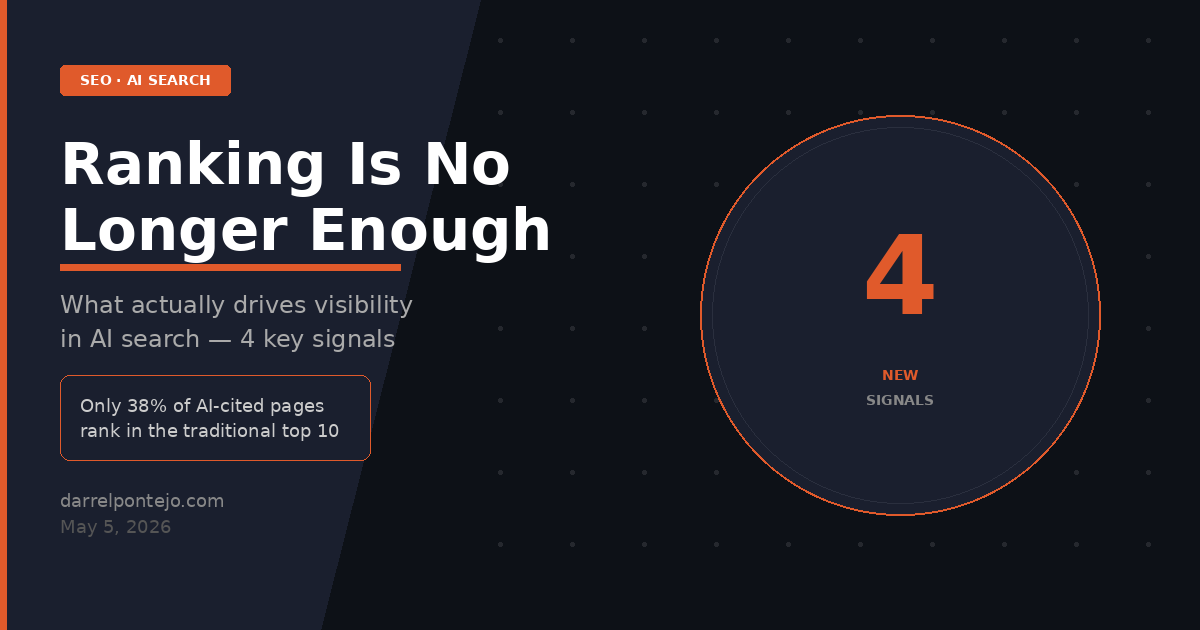
The 4 pillars Google actually wants you to focus on
Non-commodity content: the single most important concept in the guide
Google draws a direct contrast between content assembled generically from widely available information — what John Mueller had previously called "digital mulch" — and content that reflects genuine, verifiable, first-hand experience or original research.
The specific example the guide uses is deliberately precise: a post documenting a real home-buying decision — waiving an inspection, explaining the reasoning, describing the outcome — earns citation because it contains something an AI cannot synthesise from a hundred similar articles. A generic home-buying tips post does not, regardless of how technically sound it is.
Content that earns AI visibility in 2026 is content that only you could have written. Proprietary data, documented case studies, specific professional experience, counterintuitive findings — these are what make a page worth citing rather than summarising away. This is the E-E-A-T principle applied directly to AI retrieval, and it connects to what I covered in my piece on personal branding for SEO professionals — genuine expertise and lived experience are not just credibility signals, they are the content inputs that make AI citation possible.
Local and commercial: AI Mode pulls directly from your feeds
For businesses with physical locations or product inventories, the guide is specific: AI Mode sources commercial and local information directly from Merchant Center feeds and Google Business Profiles — not inferred from website content alone. As Search Engine Journal's coverage notes, the guide also introduces Business Agent — a conversational experience allowing customers to interact directly with a brand through Google Search. For ecommerce specifically, this means product descriptions need the depth of editorial copy: materials, specific use cases, comparison against alternatives, and real-world application context.
Agentic experiences: important to understand, not urgent to implement
The guide includes a section on AI agents — autonomous systems that perform tasks on behalf of users, such as comparing specifications or completing purchases. Google identifies three ways an agent can visit and interpret a page: visual rendering through screenshots, DOM analysis, and interpretation of the accessibility tree. It also references the Universal Commerce Protocol as an emerging standard for more complex transactional operations.
Google frames agentic readiness as forward-looking rather than urgent. But the practical implication is clear: a site that is difficult for human users to navigate is increasingly also a site that is difficult for AI agents to interpret. Accessibility standards, clean DOM structure, and clear information architecture serve both audiences — and the importance of this will compound as the agentic layer of search develops.
What Google says to stop doing — the mythbusting section
This is the section the industry needed most. Google explicitly identifies tactics that have circulated widely as AI optimisation strategies and states clearly that none of them are supported by how its systems actually work.
What you should actually do right now
- 1 Audit your content for commodity vs. non-commodity signals. Go through your highest-traffic pages and ask honestly: could an AI summarise this without needing to cite you specifically? If yes, that content needs original research, documented experience, or proprietary data added to earn real citation value.
- 2 Confirm your indexing and crawling foundations are clean. AI features draw from the same index as traditional search. If Google cannot reliably crawl and evaluate your pages, no amount of content quality compensates. Run a technical audit covering robots.txt, canonicals, sitemap accuracy, and JavaScript rendering issues.
- 3 Update your Google Business Profile and Merchant Center feeds. For any site with local or commercial components, these are direct inputs into AI Mode responses. Treat them as editorial content — the detail and accuracy of your feeds directly affects how AI represents your business in relevant queries.
- 4 Stop investing time in tactics the guide explicitly dismisses. Every hour spent on llms.txt, AI-specific rewriting, or content chunking is time not spent on genuine content depth, author authority, or structured data — all of which the guide does support. Redirect that effort now.
- 5 Begin an accessibility review with agents in mind. Review your site's DOM structure, navigation clarity, and accessibility tree. This is a low-risk investment that aligns human usability, SEO fundamentals, and future agentic readiness in a single workstream.
Why this guide matters beyond its specific advice
The most important thing about this guide is not any individual recommendation — it is that it exists at all. Google publishing official, consolidated AI search documentation signals that the confusion in the market has reached a point where the company felt it necessary to respond publicly and definitively.
It also closes a chapter that has produced significant wasted effort. As PPC Land's analysis of the guide notes, Google arrived at this moment after months of individual statements from Danny Sullivan, John Mueller, and other Search Relations representatives — all pointing in the same direction. The guide consolidates that position into a single, citable document.
What earns visibility in AI search is the same thing that has always earned visibility in traditional search: content built on genuine expertise and real experience, a technically sound site that Google can access and evaluate accurately, and a brand presence built through consistent, credible output. The algorithm layer has changed substantially. The principles have not.
As I outlined in my post on the future of search and AI platforms in 2026, the brands that compound their advantage over the next twelve to eighteen months are not the ones chasing the newest AI-specific tactic. They are the ones that built real authority on a solid technical foundation — and are now positioned to benefit as that foundation becomes even more directly relevant to AI retrieval.
I will be tracking how this guidance evolves as Google continues to develop AI Mode and AI Overviews. If you want to discuss how to apply any of this to your specific site or content strategy, feel free to reach out.
References & Further Reading
-
1
Optimizing Your Website for Generative AI Features on Google Search Google Search Central · John Mueller · May 15, 2026 — Official source
-
2
A New Resource for Optimizing for Generative AI in Google Search Google Search Central Blog · May 15, 2026
-
3
Google's New AI Search Guide Calls AEO and GEO 'Still SEO' Search Engine Journal · Matt G. Southern · May 15, 2026
-
4
Google Publishes Guide on Optimizing for Generative AI Features Search Engine Land · May 15, 2026
-
5
Google's New Guide for AI Search: What SEO Really Needs Now PPC Land · May 16, 2026
-
6
Google AI Optimization Guide: What Changes for SEO in the AI Mode Era Pasquale Pillitteri · May 16, 2026
- 7
-
8
Google's AI Optimization Guide: AI Search Is Still Search DemandSphere · May 2026
-
9
The Future of Search: A Complete Guide to SEO and AI Platforms in 2026 darrelpontejo.com · Internal
-
10
Multi-Platform SEO Strategy Guide darrelpontejo.com · Internal
-
11
Personal Branding for SEO Professionals darrelpontejo.com · Internal
0 Comments