
Ranking Is No Longer Enough — What Actually Drives Visibility in AI Search
For two decades, a higher ranking meant more visibility. That relationship is breaking down fast. AI search has inserted a new decision layer between your content and your audience — and it plays by a completely different set of rules.
If your keyword rankings look healthy but your organic traffic keeps underperforming, you are not imagining it. Something structural has changed in how search surfaces content — and the metrics we have relied on for years are no longer telling the full story.
I covered the broader context of this shift in my post on the future of search and AI platforms in 2026. But the data has continued sharpening since then — and I want to walk through what we now know about how AI search actually decides who gets seen, who gets recommended, and who gets ignored entirely.
The gap between ranking and visibility is widening fast
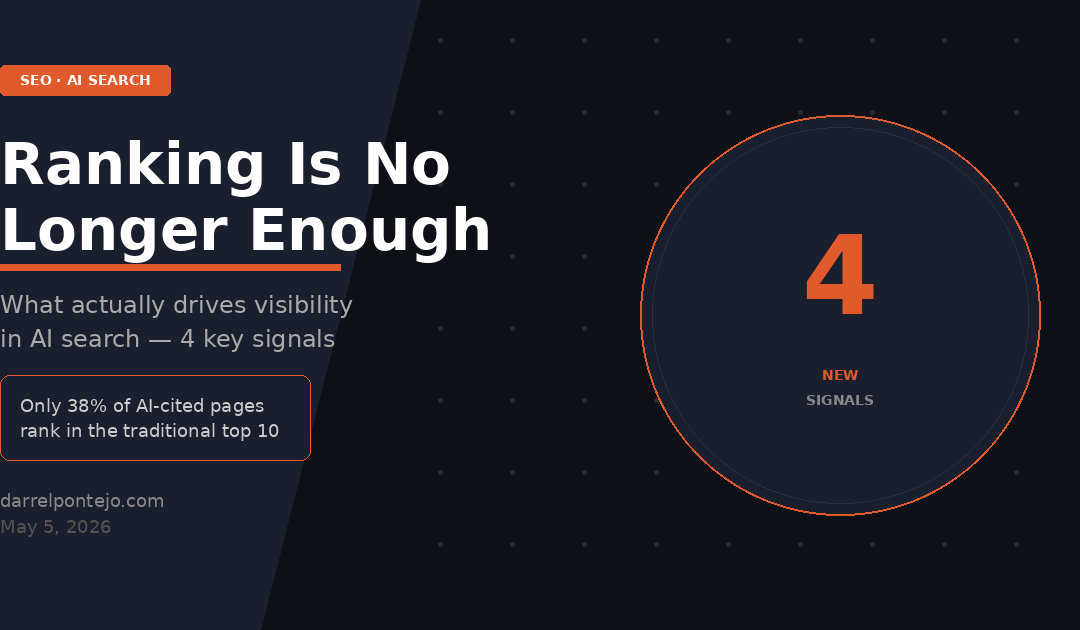
The clearest signal of this shift comes from Ahrefs, which found that only 38% of pages cited inside Google AI Overviews also held a position in the traditional top ten. Eight months earlier, that overlap sat at 76%. In under a year, the correlation between ranking and being cited dropped by half.
AI-generated answers are not simply reformatting the top search results. They are drawing from a wider, differently evaluated pool — and your position in the traditional SERP is increasingly a weak predictor of whether you make the cut.
The 4 signals that now determine your AI search visibility
Based on analysis from multiple research teams tracking AI answer behaviour across ChatGPT, Google AI Mode, and Perplexity, four distinct patterns have emerged as the primary drivers of whether — and how — a brand appears in AI-generated responses. Search Engine Land's deep dive into AI visibility signals brings this together clearly.
Signal 1 — Mention order and the weight of first position
When an AI model lists several options in response to a recommendation query, the ordering carries enormous influence. Research from Growth Memo and Citation Labs found that up to 74% of users select the AI's top recommendation without exploring further — a conversion rate that exceeds almost anything achievable through traditional ranking alone.
There is an important nuance here, though. The same study found that roughly 26% of users bypassed the AI's ordering entirely when they encountered a brand they already recognised. Strong brand familiarity can outperform position — which means brand building is not just a marketing exercise, it is a direct AI visibility strategy.
This connects directly to what I wrote about in my piece on personal branding for SEO professionals. The principle scales to business brands as well: the more recognisable your name, the more resilient your visibility becomes even as AI ordering fluctuates.
Signal 2 — Depth of explanation reflects the richness of your content
Not every brand mention in an AI answer carries equal weight. Some get a single descriptive line. Others receive detailed paragraphs covering strengths, use cases, and differentiators. The determining factor is how much substantive, citation-worthy information AI systems were able to surface about that brand at retrieval time.
Growth Memo's analysis of the most-cited pages in ChatGPT found that the top-performing URLs share one characteristic: they are comprehensive resources answering multiple related questions within a single page — what a product is, who uses it, how to choose it, and what it costs. Thin content earns thin mentions.
Signal 3 — Authority signals shape how confidently AI describes you
Beyond whether your brand appears, the language used to characterise it carries real commercial consequence. Semrush's AI Visibility Awards data, which analysed thousands of prompts run through ChatGPT and Google AI Mode, found that category leaders consistently receive confident, definitive descriptions — phrasing that positions them as the settled, trusted choice. Challenger brands, even when included, tend to receive hedged language suggesting they are emerging or secondary options.
The practical gap between "the widely recognised standard" and "a growing alternative worth considering" is not cosmetic. In a high-consideration purchase decision, that framing directly affects whether a user treats your brand as a primary option or defers it for later. Being seen is only part of the battle — being described with authority is what converts.
Signal 4 — Comparative positioning defines whose attention you capture
The final signal may be the most actionable for brands that do not yet lead their category outright. Amsive's research into AI answer patterns across industries found that users self-select almost entirely based on how AI frames a brand's positioning niche. If an AI answer describes your product as "best suited for remote-first teams," users who identify with that context route themselves to you — even if your product serves multiple segments equally well.
This means the comparative framing AI applies to your brand is something you can actively shape through consistent, targeted content — not something you simply inherit from your ranking position.
Why traditional rankings lost their predictive power so quickly
The mechanism driving this decoupling is a process called query fan-out. When an AI Overview or AI Mode response triggers, the system does not simply retrieve results for the user's stated query. It silently decomposes that query into multiple sub-queries, retrieves relevant passages from across the index for each one, and synthesises them into a single answer. A page ranking first for the top-level query may never be evaluated if the AI's sub-queries are pulling from adjacent angles your content does not address.
This process accelerated sharply when Google upgraded to Gemini 3. SE Ranking's research found the upgrade replaced roughly 42% of previously cited domains and generated 32% more sources per response than its predecessor — changes that reshaped the citation landscape within weeks of rollout.
This is exactly why I placed such emphasis on diversifying your content approach in my post on multi-platform SEO strategy. A strategy built only around primary keyword ranking will increasingly miss the sub-query retrieval layer where AI visibility is actually determined.
Where AI-referred traffic actually goes
One finding that surprises a lot of people: Semrush's analysis of 17 months of clickstream data found that over 20% of ChatGPT referral traffic routes back to Google. That share grew from roughly 14% to over 21% across the study period. Users use ChatGPT to get an answer, then head to Google to verify or research the brands they just discovered.
These two platforms are not competing for the same session — they are serving consecutive steps in the same decision journey. That has direct implications for how you think about measurement. Traffic attributed solely to traditional organic search is now partially a downstream effect of AI visibility that your analytics may not be capturing at all.
What you should actually be measuring now
If ranking position is no longer a reliable proxy for AI visibility, the measurement model needs updating. Here is what a more complete picture looks like in 2026:
- 1Citation frequency — how often your brand appears when AI systems answer questions in your category. This is the primary visibility metric for AI-driven queries, replacing ranking position.
- 2Brand mention rate — out of all AI-generated answers in your category, what percentage include your brand? Scores above 70% indicate strong AI visibility; below 30% signals a meaningful gap.
- 3Recommendation rate — being actively recommended carries more weight than appearing in a general list. Especially critical for B2B and high-consideration purchases.
- 4Sentiment and framing — how AI describes you: premium or budget, advanced or entry-level, reliable or experimental. These descriptors shape purchase intent in ways that position number never did.
- 5Citation position within answers — first-cited status in an AI answer is achievable without a top organic ranking and carries comparable influence on user behaviour.
New tools have emerged to track these metrics specifically — platforms like Profound, Gauge, Peec AI, and Scrunch for citation monitoring, and Semrush's AI Visibility Toolkit and HubSpot's AEO Grader for brand positioning analysis. These do not replace traditional SEO tooling — they sit alongside it as the measurement layer for the AI retrieval tier.
What this means for your content strategy right now
The practical shift is less dramatic than the underlying change in search behaviour might suggest. The fundamentals of producing genuinely useful, comprehensive, and authoritative content are more important than ever. What changes is the orientation and the scope.
Content that earns depth of explanation in AI answers is content that thoroughly addresses a topic from multiple angles within a single resource. Content that earns authority framing is content that has been consistently referenced and built upon across credible sources over time. Content that earns a specific comparative positioning is content that directly and repeatedly addresses a defined use case or audience segment — not content that tries to be everything to everyone.
The brands maintaining strong AI visibility right now built genuine authority before the shift happened. Thin optimisation and keyword-first content approaches do not appear to earn meaningful AI citation. The citation pattern rewards depth, consistency, and real usefulness — exactly the same foundation that sustainable SEO has always rested on, just applied with greater intentionality toward the AI retrieval layer.
Ranking still matters — but it is no longer the whole story
Traditional organic search still drives traffic, and the technical and content foundations supporting strong rankings also support AI visibility. But measuring success exclusively through ranking position in 2026 means ignoring a growing portion of the search landscape where different rules apply.
The brands and content creators who adapt their measurement and content approach to address both layers — traditional rankings and AI citation signals — are the ones building compounding visibility advantages over the next twelve to eighteen months. Those optimising only for blue links will watch their share of voice quietly erode, often without clear attribution in their analytics.
I will keep tracking this closely and publishing further analysis as the landscape evolves. If you want to discuss how this applies to your specific site or niche, feel free to reach out.
References & Further Reading
-
1
4 Signals That Now Define Visibility in AI Search Search Engine Land · Wasim Kagzi · April 29, 2026
-
2
AI Overview Citations vs. Top 10 Rankings — The Overlap Is Shrinking Ahrefs Blog · 2026
-
3
The Science of How AI Picks Its Sources Growth Memo · Kevin Indig · 2026
-
4
How Consumers Navigate High-Stakes Decisions in AI Search Growth Memo & Citation Labs · 2026
-
5
Gemini 3's Impact on AI Overviews and Citation Patterns SE Ranking · February 2026
- 6
-
7
The Future of Search: A Complete Guide to SEO and AI Platforms in 2026 darrelpontejo.com · Internal
-
8
Multi-Platform SEO Strategy Guide darrelpontejo.com · Internal
-
9
Personal Branding for SEO Professionals darrelpontejo.com · Internal